The music of the spheres

Image

Every day at 2pm during the exhibition of Peter Blake’s illustrations for Under Milk Wood at the National Museum, Cardiff, the usual hush of the gallery was filled with “The sounds of the spheres”. Instead of the classic Richard Burton recordings of the work, the gallery chose a 1988 production by pop music producer George Martin to soundtrack Blake’s vibrant, affectionate and dazzling works.

On Sunday 24th January 1954 the final recordings of the BBC’s first production of Under Milk Wood were made at Broadcasting House  having accommodated Richard Burton’s hectic acting schedule. The director Douglas Cleverdon had already gone to Laugharne to record children reading “Gwennie kiss the boys” and the song “Johnnie Crack and Flossie Snail” as well as location sounds. Technically the recording used what might now be regarded as crude techniques – reel to reel analogue tape and manual editing (that is a razor blade and sticky tape!). That this production is still one of the defining recordings of the work is perhaps due to the fact that “though technically straightforward, the original 1954 broadcast of Under Milk Wood still seemed most wonderful. It was a different world”.

Walford Davies’ introduction to this version soundly places the work in the context of a heard experience: “our reading is richer if it also hears (his emphasis) the work, as a “play for voices’.”  The original recording took place at a time when radio was still an important medium and for Dylan Thomas “this, to me, unbelievable lack of wires” was key to the delivery of his words. Radio also was – and still is – “by its very nature synchronic, in the strict sense of everything coinciding in time but not in place”. [ibid] This allows the writer and production director limitless – except by the technology – capabilities.

There was little music in the BBC 1954 production. The record producer George Martin for his 1988 ‘celebrity recording’ as Davies describes it, was able to envisage sound worlds quite impossible to create 35 years earlier. Digital recording, where sound is directly recorded as data, omitting the analogue stage of covering sound into waveforms, was the new boy on the block. Equipment allowed recording of 32 separate tracks, all synchronous but not mixed together until the end. Stereo recordings meant that individual voices and sounds could be ‘moved’, placed in context to each and the listener. This is a clearer, more direct, and potentially more dramatic way of delivering a reading. Already the doyen of the industry (producing most of the Beatles’ output for example) George Martin wanted a recording that stretched the technology as well as his directorial skills and imagination. This presented issues, for example with sound effects. In 1988 there were extensive ‘libraries’ of stock sounds eg children’s voices, clocks, bells, waves but these were all analogue recordings that would jar in an all digital one. So even the simplest thing – the silence of Laugharne – had to be specially recorded using digital recorders. The children of Laugharne got another outing.

As well as  all-Welsh actor voices – with the exception of Alan Bennett reading the ‘Tourist Guide’ – Martin wanted music. This meant actors who could sing, or at least work with music, for example a masterly Freddie Jones as Captain Cat, and singers who could represent the very best of traditional Welsh music and act, such as Mary Hopkin. Sir Geraint Evans could of course easily carry Eli Jenkins’ morning prayer with the music of Troyes’ Chant, but could he act as well? Well, as an opera star of great distinction, of course he could.

Other key musical voices were Bonnie Tyler singing Polly Garter’s “I loved a man” with music by Elton John, and the ever popular Tom Jones with a rollicking pop number in “Waldo’s song”.

There is an introductory musical soundscape too and music used as ‘under beds’, heightening the drama at a few significant points. Although Woody Guthrie’s Dust Bowl Ballads (1940) is considered one of the first concept albums, consisting of semi-autobiographical songs about the hardships of American migrant labourers during the 1930s, it is only in the late 1960s that producers/directors/musicians developed the idea of a record album – or two in this case – being a continuous narrative. Martin’s Under Milk Wood was a musical interpretation of a radio drama, or play for voices, or a concept album. Whatever.

The critical test of Martin’s production is twofold for me: does it achieve Dylan’s desire to be a ‘wire-less’ transmission of his characters, their story and ideas; does the directorial intervention add to the listener’s enjoyment and appreciation of the work?

To be tested after 35 years, particularly in the context of Peter Blake’s visualisation of the same work – and to which similar tests might be applied I feel – is a hard one. I selected 12 tracks, mostly musical, and linked them for a radio – yes radio – piece which you can now hear online as a podcast (see note about voice quality). In my view the recording has aged well: well, perhaps not the europop writing of “Waldo’s song” so very well, but Tom Jones of course carries it off. Does it develop, deepen, enhance the words of Dylan Thomas? Undeniably. For me, Freddie Jones and Mary Hopkin are the definitive rendering of his love song. As for the actors: peerless even compared with the BBC original.

It is then perhaps no surprise that every day for the duration of its exhibition, National Gallery Wales has given us this George Martin version of Under Milk Wood in preference to others. An inspired choice.

My track selection:

1 Main Theme: Under Milk Wood – A Play For Voices

2 First voice Anthony Hopkins:  “To begin at the beginning” ___ to “sleeping now”

3  Captain Cat to “Oh my dead dears” 2:14

4 Guide Book: Alan Bennett

5 Song: Johnnie Crack And Flossie Snail

6 “The sound of the spheres” and Second voice: to “primrose grows”. 0:39

7 Song: Polly Garter, Bonnie Tyler – ‘I Loved A Man’ edit 2:19

8 Now when Farmers Boys edit to “Donkey Down” 2:04

9 Song: Rosie Probert And Captain Cat – “Love Duet”

10 Song: Morning Prayer Eli Jenkins

11 Song: Waldo’s song edit 2:54

12 Song: ‘But I Always Think As We Tumble In To Bed…’

Hear podcast of my radio piece at: http://www.pdconair.com/Peter_D_Cox/Media/Entries/2014/2/21_Celebrating_Dylan_Thomas_100.html

Why I will not be renewing my subscriptions to the iPad versions of The Western Mail and the S W Echo

The technical stuff

The editions for iPad use a standard PDF (portable document format) presentation and not a specially designed one for an on line edition, like the award winning Guardian iPad edition. The pdf simply reproduces each page as it is printed. There is no additional editorial or design intervention to present the information in a tablet/iPhone format. After page one, the pages are presented in a two-page spread: on an iPad you can read the headlines, but little else. To read an individual story the text has to be expanded – often very slowly rendered to be readable – and the text of the story will not be isolated from other text around it. If a story runs from say page one page to page four there is no dynamic link – you have to scroll through the pages

There is a mini-page view – so you can skip sport for example – and there is also a completely useless text page listing. There are no:

  • ways to search the edition
  • ways to search across editions or to link related stories
  • ways to save, bookmark or print an individual article
  • no way to tweet or send a link to an individual story. To achieve all these things you have to access the (still very poor to navigate) WalesOnline website.

Issues often arrive a long time after I would expect to read them ie with my tea at 7 AM. Even with high-speed broadband, downloading takes a significant time and is not carried out in the background automatically – as with other publications.

The application itself is buggy, the simplest action e.g. zooming or scrolling page, can cause a complete crash.

Technically this is an outdated and very poor implementation of the new technologies. Although none are perfect, there are plenty of high standard iPad newspapers to copy from!

The editorial stuff

iPad edition front pages The Western Mail

iPad edition front pages The Western Mail

The major editorial problem for these online editions is the way in which they allow the reader to make quick comparative judgements which are not so easy with the printed editions, even if you put them on a table side-by-side. As such it gives the reader the technology to understand just how poor the editorial content of both newspapers is.

SW Echo iPad

The iPad edition front pages of the SW Echo

The “homogenisation” of TrinityMirror Newspapers editorial is painfully plain to see in the digital editions. Although supposedly “the national newspaper of Wales” lead news stories in both newspapers can be same. In any pair of editions it is easy to find near identical stories reproduced with little or no regard to what should be differentiated readers. This is as true of national coverage as local.

In terms of assessing editorial quality and readability the digital editions make scanning articles oh so simple – on average I have seldom read more than two or three complete articles in any edition of either newspaper. Skimming takes longer with printed pages but it doesn’t mean that the editorial quality is any greater. Because the iPad edition is simply a rendering of a newspaper editorial choices become even more vivid and pronounced: take the B-list, personality-led, front pages of the Western Mail for examples. Or the massive second-coming headlines (usually followed by less than a paragraph of copy) front page screamers on the Echo. Neither approach is suitable for new media presentation.

In summary, and sadness, then

Perversely perhaps, one months digital editions have simply proved to highlight all the worst (rather than best, there must be some!) of the two newspapers. Yes, digital presentation is content, content, content. And here these newspapers show up very badly. But there is also sufficient experience now to know that simply delivering photographs of the print edition is not a digital edition. The Guardian and the Daily Mail have massive online presence in their web and in tablet versions because of the interaction of readers and the additional value that these editions can have over the printed page..

Sadly, online editions of tThe western Mail and SW Echo will do nothing to stave off the relentless decline of newspapers in Wales, and even more importantly, good reporting of life in this country.

If this was an end of first term report it would barely rate 3/10.

Sunday supplement, BBC Wales, 10 March 2012

  1. Share
  2. Click on the orange arrow to play the edited clip from the show. 
  3. Forgetting who your customers are – first blood to Tesco, then Golman Sachs’ muppet clients; why parents make the best parents and the absurdity of honours and honorific titles.

    You can catch the others stories and here the programme (we are the last fifteen mins or so) here http://www.bbc.co.uk/programmes/b01dnbqq

A Welsh High Tea

This was written following a glorious September day. Sadly, it is now finished. You can either read it, or hear it.

A Welsh High Tea

A sunshine filled September day,
the dining room doors framing a view of a few fields
leading us to the expanse of sea that is Rhossili Bay.
The room filled to overflowing: standing on the deck, the grass,
against the field fence where the ponies graze.
Families – the sisters, nieces, aunts and uncles,
the friends from a lifetime of 80 years to the day.
Gathered for High Tea.

A much extended table laid with precision.
Competing aunties’ Bara Brith and Welsh cakes.
Tiny shells filled with lemon cream atop with raspberry, singular.
Sandwiches, definitely for an occasion,
narrowly cut, stuffed to overflowing,
trimmed of crust and neatly laid.
Remembered recipes of jam dipped sponge squares,
coated with coconut shreds,
finished with cherry jam and a cream blob.
Scones, by competitive sisters this time:
small and perfectly stuffed;
or ready to break yourself and indulgently fill,
with more cream and home made jam.
And, more, too much to see, too much to eat.
Celebration for every sense.

In the centre the cake, the birthday cake.
With the champagne, the wishes
“Penblwydd Hapus” by most,
plain “Happy Birthday” the rest.
But the “iechyd da” felt hollow even as our glasses met.
No shared joy blotted out unsaid thoughts.
We knew: no tea would ever be as bitter sweet,
however bountiful or lovingly made.
The sun would never fall on her so radiantly.
The wake, too soon it was to be,
would be no match for her High Tea.

Doreen Page 12 September 1930 – 5 November 2010

©Peter D Cox 2010 all rights reserved

Rapid Fire presenting

Peter Cox at Cardiff PechaKutcha

Peter Cox talks about changing Cardiff at PechaKucha Photograph: Hannah Waldram/guardian.co.uk

I got my blooding at the PechaKutcha in Cardiff on 27th May when the Guardian kindly blogged:

Peter Cox from Cardiff Civic Society gave a compelling insight to how Cardiff is changing and what elements have been lost along its development. He said:
“Cardiff’s growth has been both sudden and exponential. The city of 1891 is barely recognisable as apparently unstoppable expansion consumes whole communities.”
Cox praised the design of Chapter Arts Centre, where the event took place, for being inclusive, community focused and putting society at the heart of the building.

On that occasion it was 20 slides and 6mins 20 secs to complete – a pretty rapid fire.

But last week’s IGNITE#5, part of the Swn Festival, held at Chapter Arts was down to 15 secs a slide – and no messing, they advance relentlessly. Unlike the PechaKutcha, Ignite had a theme – Music not surprisingly. A good opportunity I thought to extoll the virtues of hospital radio, and of course, Radio Glamorgan in particular. The other presenters were amazingly diverse: a bluffers guide to Bollywood, rock t-shirts, my first heavy metal festival. Great fun and entertaining. Well I was off first (partly because of the inevitably complicated presentation, but I wanted to include sound and video – off course). But all was well in the end.

Snippets included some of my interviewees (click to hear the full length interviews on my web site): Tim Rhys Evans (Only Men Aloud) Joan Armatrading, James Dean Bradfield, Kevin Brennan MP (in his guise as part of MP4) and Rebecca Evans. All ace.

Technically for the nerds: the video comprises the original slide show with a soundtrack taken from a live recording (using an Edirol R-09 miniature digital recorder with integral mic) mixed to sound tracks that were used on the slides. I used Amadeus for the sound editing, QuicktimePro (v7) to slip the tracks and merge the new sound track and exported to YouTube as Mpeg-4.

The nonsense of the NOS ‘sex’ survey

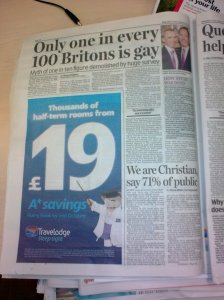
In that parallel universe of Daily Mail and Daily Telegraph readers there was a mass explosion of relief this morning. Curtains will have twitched across the nation as the worst fears of many were assuaged with the Daily Mail’s social affairs correspondent (sic) categorically assuring the threatened masses that they were not surrounded by a huge percentage of gay neighbours: it’s official, only one man in 10 is gay and less than a whole woman is a lesbian. What relief then.

Daily Mail story

Today's Daily Mail reassurance to its readers Credit: http://twitter.com/catherine_mayer

I’ll quickly pass by the unquestioning, slovenly and uncritical journalism of the Mail since that is what we must expect, sadly. A more considered appraisal of the National Office of Statistics survey is in the Guardian. But, even there, the report needs to be taken with a massive dose of common sense and comments (I didn’t dare look at the DM’s) raise many of the issues that concern this report.
As someone who has commissioned and helped design some pretty groundbreaking market research in my time, I hesitate to tell the NOS how to do its work. This survey is, as many point out, deeply flawed. I have no issue – albeit by a government paid-for quango –seeking to go where others fear to tread, indeed that maybe their role. But given that every homophobic newspaper would glibly misinterpret unquestioningly its results, it really should have been more careful.
When teaching questionnaire design I always proposed two rules:

  • only seek answers that you can do something with (useful, not just ‘interesting’);
  • only ask questions to which there is a definitive answer and that can actually be answered.

I am not at all sure what purposes the NOS is intending to use its data for: predicting levels of ‘hate crime’ perhaps; managing growth of same sex households and their demands for schools? Mmm.
The question itself is perhaps more interesting: is there a valid answer to the question “What is your sexual group?” Given a list (and the methodology employed by NOS seems to me wholly flawed – why didn’t they use self-administered computer based trade-offs, for example?) first of all assumes that people accept the idea of a group definition. Many would not, yet they might engage in behaviour that is a characteristic, supposedly, of such a defined group (all ‘gay’ men like “Mama Mia”). The behaviour itself simply defines an action at a particular time: so a man who marries a women and has children, then lives with a male partner is what? Depends when you ‘measure’ what behaviour – the relationship, having children, sex with a man or a women. And at what point does the behaviour characterise the person as being part of a ‘sexual group’?
In such complex circumstances people will always moderate their answer to the most favourable light – as they see it – at that particular moment: doctors have rules of thumb for what people say their smoking/drinking/sex habits are. They may also have personal qualifiers that shape their answers: some men who have sex with other men who are the ‘active partner’ do not regard themselves as homosexual at all, but regard their sexual partner as such. That may be a valid description for that person but it wouldn’t have helped in this survey to arrive at a useful, valid answer.
The safest, most reliable way of getting data is to ask about actual events that can be reliably recalled. When did you last have sex with another person? What gender was that person? Do you have sex regularly (monogamously even) with that person? Are you in a long-term relationship? What sex is that person? And so on, building a volume of behavioural information that is more likely to be accurately recalled – but not necessarily truthfully told unless the methodology is secure. Take a group of answers together and you might, only might, be able to lump them into a group behavioural description: gay, bisexual, lesbian, whatever. I’m not going to even attempt to do that!
So, while this survey is interesting, it’s far from useful and probably not valid. If it gives comfort to homophobes then perhaps that can’t be bad. But watch out. Whatever the DM and Telegraph might tell you, the chances are you have a gay, lesbian, transgendered – or just plain heterosexual kinky – neighbour. Keep twitching those curtains.

End of the Maskrey’s era

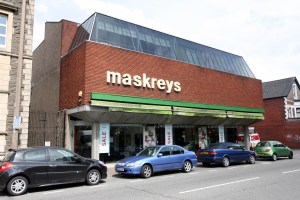
The iconic furniture store that was Maskreys, Cardiff

It was the new social barometer Twitter that gave the first indication of the storm that hit the iconic south Wales furniture stores Maskreys. The immediate reaction from Tweeps was sadness. Maskreys, after all, is – until the end of November – more than just a furniture shop. Since 1898 the Maskrey family have been delivering, to a very particular south Wales market, an aspirational lifestyle that can only be hinted at by Cardiff upstarts like John Lewis, and the can-hardly-mention-in-the-same-breath, IKEA.

Others have remarked today that if Maskreys had adapted their buying policies then maybe it could have survived the competition from the comfortably upmarket John Lewis and the aggressively do it yourself IKEA. That seems to me to entirely miss the point! The three stores were always designed to be the bastions of a certain kind of taste (not always so obviously ‘good’): something that bordered on bling, but was rescued from crassness by craftsmanship and, yes, mostly unattainable for the likes of us, pricing. It meant the comfort of having bought something that would last for ever, reinforced by a feeling of painful expense, and the knowledge that everyone would admire your purchase.

I am sure there was another kind of customer as well: the moneyed for whom price guaranteed peergroup (The Jones next door) approval, even if sometimes the objects were themselves of doubtful taste.

Does it matter then that Maskreys is to disappear?

Robert Maskrey (executive chairman) and Samantha Maskrey


I think so. Firstly, there is the cost to the people involved. I have known Sam Maskrey, and her husband and executive chairman Robert through our common interests in the arts. Of course, they are entitled to retire and their orderly closure of the business, the wanting to do the best for their customers and their staff, is more than anyone can reasonably expect in a slash and burn recession.

The Cardiff store has been on Whitchurch Road since 1913. This is not the most suitable location for such an enterprise but it must be an important draw for many of the other businesses that now exist in the area. (The other most important attraction locally is Cathays cemetery!). There will undoubtedly be a knock-on, recessionary effect on those businesses. The Cardiff building is attractive of its kind but will almost certainly fall into a developer’s hands and an unsympathetic, unsuitable replacement is par for the course in Cardiff’s current planning–free–for–all.

And apart from the Maskreys business, there is equally significant potential loss of Sam and Robert Maskrey and their roles in the cultural life of Wales. The company itself sponsors the Hay Festival of Literature and the Welsh National Opera. Robert Maskrey has chaired the Lower Machen Festival for five years. Sam Maskrey is a director of the Hay Festival of Literature, deputy chair of Arts and Business Cymru and is on the board at Chapter Arts Centre. Sam and I met at Chapter when she joined the board and I managed to persuade her to take very active role in fundraising for the recently completed £3.5 million redevelopment. Without her enthusiasm and arm bending it is unlikely that Cardiff would have the benefit of the new Chapter.

It isn’t impossible, I imagine, for individuals to set up and run and businesses like Maskreys. But as a recent report on the homogenising of our high streets has warned, it is increasingly difficult when companies like Tesco regard land banking and the saturation of communities with their multiple outlets as the way to generate the highest return to shareholders. The idea of a business that delivers a particular range of products in an individualistic way for a carefully focused market depends on the market existing and being able to accurately deliver what they need. Fashion, times and financial ability are all fickle.

There is everything to commend in the manner of Maskreys departure. But many of us will notice the absence of the store and the qualities that Sam and Robert bring to life in Cardiff. For the past 12 years they have sponsored an annual Christmas carol concert held in the Norwegian Church, Cardiff Bay. That alone has raised £150,000 for Shelter Cymru. It’s not just the rich furnishing their eye-wateringly expensive flash pads, it’s the homeless who will miss them too.

Rolling back blog history

What’s with the reminiscing stuff? First I get asked to reflect on my own ancient history – politics wise – and then there’s the urge to ensure that all my blogs are got in the same place, again. This latter task is proving tedious technically (anyone out there a Notes Designer who can do me a dump from my Domino Blog?); emotionally jarring (have to read every word and relive the memories), and altogether too time consuming/diverting when I should be writing about now.

Guardian Blog 2003

What the Guardian Weblog looked like in 2003 when it announced the Best British Blog winners

Basically I’ve been through lots of iterations: first off was a Blogger blog (it was this that got the much dined-out-on shortlisting in the inaugural Guardian Best British Blog competition in 2003). These blogs got transferred into several versions of the cutting-edge Lotus software based on Domino Blog, which I had a small part in helping to shape before it was consumed into IBM.

This software allowed me to do things that freebies like Blogger and WordPress couldn’t then do, and it was all hosted on the office servers, so it was effectively free.  And, IMHO, it looked great too.

Peter D Cox in 2003

Using Domino Blog in 2003 until about 2009, this was an early design

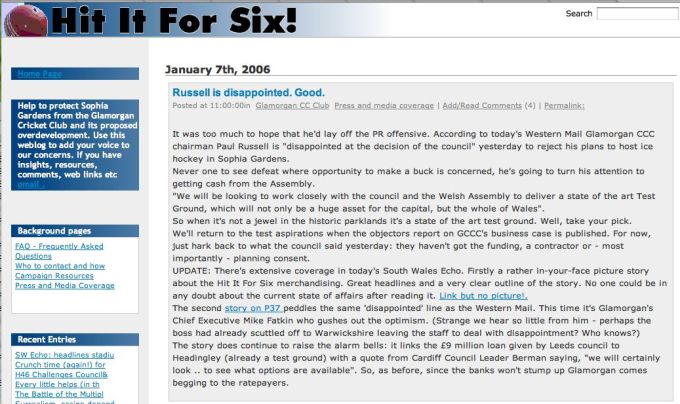
Of course, as a by now famous blogger (well, I knew how to do it technically, could string two words together, and got angry about things – the pre-requisites I suppose) it was clear I’d get to have other blogs too. The biggest, and to date the one which has atracted most online comments, often hundreds, was that for the HitItForSix campaign. In the campaign to save the historic Sophia Gardens (part of the Bute Parks) from the desecration of an international cricket arena it was clear, even in June 2005, that people needed a web place to go if they were to campaign effectively. Copies of plans, papers, proposals were often ‘available’ but effectively lost in obscure places and frequently ‘disappeared’ as quickly as they were published. Archiving and recording on H46 was a powerful tool for campaigners and journalists.

HitItFor6 web blog

The campaign blog for HitItForSix, campaigning against Glamorgan Cricket Club's massive cricket arena (and originally ice-rink and pavilion)

Hundreds of blogs later we ultimately lost the campaign  as local politicians rolled over at the lure of a Test Cricket Match in Cardiff. Footnote Tweet:Value of Ashes to Cardiff: prediction June 2009 £116M http://ow.ly/2cfhA , report to #cdfcouncil says £3,577,000 http://ow.ly/2cfhB Compute? 16 July 2010.

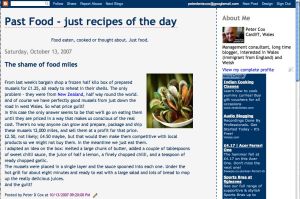
Food Blog

The food blog, a nice diversion while it lasted. I'd still like to write a food column: any offers?

Another flattery-got-the-better-of-common-sense-diversion was a food blog. From September 2007 until November that year I managed to write pretty consistently about food eaten, seen and cooked: from sauerkraut to Nigel rip-offs it was great fun while it lasted (and all the blogs are on this site, hence the pre-dominance still of food in the categories!).

Once I became ‘retired’ using the office servers was no longer an option so some consolidation was necessary. Blogger seemed v inflexible and not very designery, and WordPress seemed the choice of ‘serious’ bloggers, which I liked to think I was. So the, as yet unfinished, task of moving things over began.

And there we are. Well almost.

January 30th 2009 saw my first Tweet, though it took about six months to work out what it was all about. Now, 3442 tweets later, I think I’ve got it sussed, have been described as “Cardiff’s acid Tweeter” – a description repeated by the city’s leader at a recent meeting, and by the South Wales Echo (27 July 2010) as one of the five tweeps (people who do) to follow. Tweeting has filled a big hole in the blogsphere for me: giving almost instant reposts to news and events; highlighting and commenting in 140 characters on things that take my fancy; and following others of a like mind (and not) who do the same. It’s great.

And just in case you miss them. I archive them here, on the blog. A neat development. For now, until it all changes again.

So, in seven years blogging has changed a lot, technically and in the writing. The short-and-sharp gets Tweeted. Much comment gets cuckoo’ed out onto other people’s blogs where you fight for a voice amongst an often crowded space. And nice people ask you to write for them. All in all then, I’ve become a bit of a philandering blogger.

And a postscript: Much of what I have written and the illustrations would not have been possible without the amazing web archive feature on http://web.archive.org/. Let it be a lesson: very little on the web actually disappears.

Another sort of writing?

Not only do I fail to keep this blog up to date (Tweeting has to substitute sometimes for active engagement here), but I don’t get my homework in on time either.

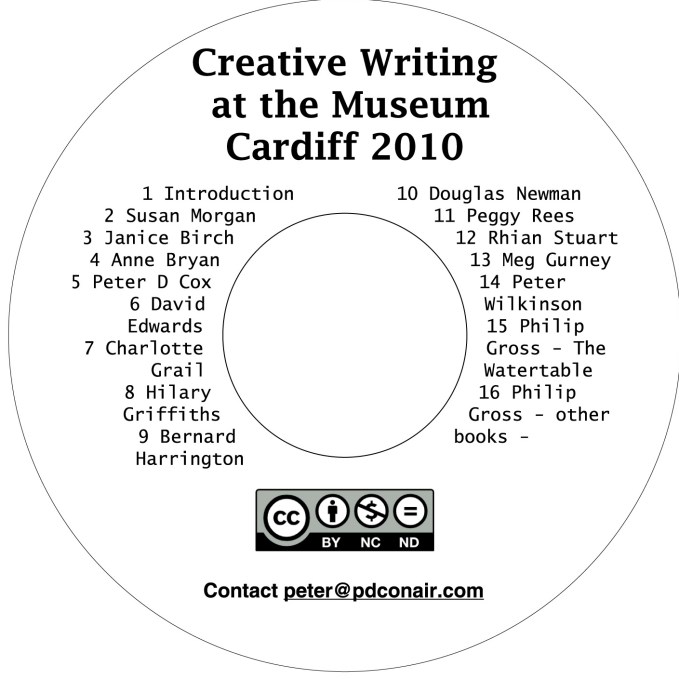
CD cover for end of course readings with Philip Gross

CD cover for end of course readings with Philip Gross

Homework? Yes, during term time I’ve been trooping off to Cardiff University – well actually to the National Museum in Cardiff – for a weekly dose of “Creative Writing”. The other stuff. I thought I’d better ‘fess up, so here’s a piece I wrote explaining all about it. (Recycling is good!)

And if you’d like to hear how we got on, here’s the recording of the end of term bash – some great stuff from others (I do a monologue which somehow manages to squeeze in the Manic Street Preachers). Oh, and Wales Book of the Year Author Philip Gross does beautiful readings at the end.

Creative writing at the Museum, 2010 class six homework: 300 words on  your creative writing course Course tutor, Susan Morgan

I have been a professional writer for nearly 50 years since that first, paid-by-the-word, journalistic prose appeared in “Teen Scene” in the 1960s. Hundreds of thousands of those  pesky words later there has been: art criticism, news reporting, voiced radio scripts, appraisals, tender bids, university essays, presentations for groups ranging from 2 to 2000, Tweets, blogs, and reports, endless reports of immense expense to clients and comparable cost to the creative abilities of syntax, choosing the bon mot, engaging one’s audience, presenting facts, drawing conclusions, and, above all, staying awake. I am a creative writer!

Alarmingly though, not a “creative” enough writer even though I could boast – if asked –  of a slim volume, half a century ago, of youthful poetry, some voiced on the Home Service radio program “Poetry Today” by the stellar Mary Wimbush.

So, off to the University of Cardiff Creative Writing at the Museum Course where I was to to spend 10 weeks focusing my gaze on every conceivable aspect of the Seven Estuary. I was to discover one of the world’s most important tidal reaches, rich in biodiversity, archaeological remains, myths and historical occurrences. This would provide an abundant resource, based on lectures from scholarly, witty and erudite members of museum staff, and objects from the National Museum itself, for the simple task called “home work”.

Go write a monologue. Produce a short poem. Collect an interview. Experiment with riddles and kennings. In short, discard those years of practice and produce succinct, accessible, vivid and above all well constructed pieces that communicate in a way that can grip, move, inform and, ideally, change people’s perceptions and lives!

That’s what others in the group did with varying degrees of, and often very profound, success every week. As for me?  Well I’m signed up for the Autumn.

Why we live in Cardiff: guest blog

This Guest Blog was requested by WeAreCardiff and appeared on their blog on August 27th 2010

Yes, I am still, frequently, asked the question by uncomprehending friends “why do you live in Cardiff?”. As a south Londoner (political history here), I migrated here via the very beautiful countryside of north Warwickshire.

My work as a consultant took me from the heart of England all over the UK, quite a bit of Europe and even North America. But I had a client in Cardiff that meant five years of staying almost every week at the Holiday Inn (now the Ramada); stays that included the delight of Michael Jackson’s suite. An artificial kind of “getting to know you Cardiff” maybe, but it planted a seed that led to me renting a flat for six months to work on a book.

Llandaff, one of Cardiff's many 'villages'

Then, much later, the suggestion to my partner that we try a year in a rented flat in Llandaff to see if we really liked Cardiff. A year after when we were being kicked out we had to decide: to relocate permanently or return to leafy Warwickshire. The decision was taken out of our hands when the house there sold and, on the same day we found a home in Pontcanna, we bought it. We didn’t know then that this was one of the most desirable parts of the city, and that we were surrounded by Welsh speakers and media personalities. As time went on, we met with like-minded immigrants, as well as delightful neighbours who had been in the area for 40 or 50 years. We tried, repeatedly, to improve our Welsh.

It took a while to get to know the extraordinary delights of the adjoining Pontcanna and Llandaff Fields

Llandaff Fields in Autumn

Llandaff Fields in Autumn

and the way they form part of the Bute Parks. The arrival of Dryw – black, four legged and a terrier explorer – accelerated our learning. However, we quickly discovered that many of the things we most liked about Cardiff were under threat. First it was Sophia Gardens – the city’s first public park – and the idea of giving a privately owned company a huge amount of public space in which to develop a commercial cricket ground.

Sophia Gardens in its glory days

Sophia Gardens in its glory days

The “Hit it for Six” campaign successfully fought off two major applications for development in this grade 2* parkland, but the promise of a “test match” and of some fleeting international exposure saw the council roll over like lapdogs and agree to the desecration of the park. An action that can never be reversed.

It became clear, sadly, that this was part of an ongoing process of degradation and development, usually claimed to be for “worthy causes”.

40 years of encroachment of the Bute Parks

40 years of encroachment of the Bute Parks

Each of these individual uses may have seemed to have some merit, but taken together they have added up to a 40% removal of public space from one of the country’s most important historic landmarks. Sophia Gardens was effectively finally lost when the cricket stadium was built, but we all thought Bute Park itself was untouchable. The allure of money from the Heritage Lottery Fund and weaselly words of support from them, enabled the council to build a new access road to enable it to undertake public events more easily. A 5000 people petition asking for a moratorium on development in the Bute Parks was dismissed in a council meeting in seconds.

At this point anyone would question why they would still want to live here. Now, there is as much to get angry about in Cardiff, as there is to enjoy.  As chair of Cardiff Civic Society, a charity not a political or single-issue campaign, I have a responsibility, not to be angry (well, not just angry) but to try to ensure that Cardiff’s historic past, and just as importantly, its future, is in the ownership of its citizens. Not, as so often seems, taken for granted by its politicians as their right to propose and dispose of at will.

We are coming up to an important time for those who make bad decisions: it’s the Welsh Assembly elections next year, council elections in 2012. It’s a good time to reflect on what has happened, and what we might want for the city in twenty years’ time.

Cardiff has the potential to be a fitting capital for the country where many of us still want to live. Indeed, it can and should be a world exemplar of many of Wales’ policies for the environment, sustainable economic growth, high standards of built design and caring for a remarkable and complex history.

It won’t be that in 2020 unless we, the people who have grown to love the place, make it so.

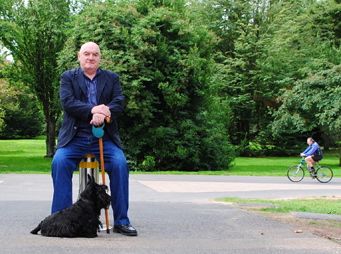
Picture by Adam Chard taken for WeAreCardiff

Peter sits on an access bollard by the new Bute Parks access road bridge: “its presence allows the noise, traffic and pollution of an arterial roadway into what was once one of the most preciously tranquil areas of the heritage park. The massive, industrial strength bridge (for 40 tonne lorries) has the design footprint of a monster and less subtlety than the second Severn crossing. It destroys something given in trust. It’s an irrevocable act of vandalism that history will join those who campaigned against it and roundly condemn as a folly of 21st century politicians seeking civic aggrandisement above civic duty.”