A Phoenix rises from The Persians

I cannot imagine that there are many who had the good fortune to see The Persians (background story) over the past two weeks, who doubted that we were present at one of the defining occasions of English-language theatre in Wales.
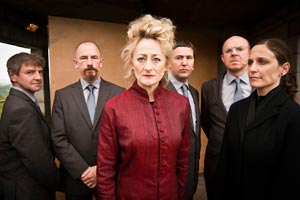
The cast of Mike Pearson's NToW production of The Persians

Even the London critics somehow managed to find themselves seated, not in West End luxury, but on a hard bench, clad in a regulation green poncho and exposed to the elements deep in the heart of the Brecon Beacons.

All have heaped praise on the National Theatre of Walessixth production in this year’s inaugural programme of The Persians, directed by Mike Pearson.

“They have scored a coup”, The Observer; “Pearson’s superbly imaginative and intense production, at once timeless and modern, has a rare, raw power. This is great theatre – and a thrilling mystery tour for its audience”, The Telegraph; “a production that is both minimalist and massive in its scope and marvellous in its realisation,” the Hereford Times; “what is impressive about Mike Pearson’s production is the totality of the experience”, The Guardian; “some of the finest creative talents working in Wales today… melded together to produce a unique and exciting drama, probably accompanies most artistically fulfilling production to date”, Michael Kelligan; “with the eery music, some wonderful acting and the amazing setting, this is another hit for National Theatre Wales”, Western Mail.

Yes it is all this and more. But for me, on quiet reflection, there is a story behind the production that I haven’t yet seen discussed.

The Persians represents in many ways a Phoenix like rebirth of one of Wales’s greatest theatre companies –  Brith Gof. Firstly, director Mike Pearson, conceptual designer Mike Brooks and composer John Hardy were all key players in Brith Gof’s history. Richard Huw Morgan, John Rowley and Gerald Tyler are all actors who have worked often for extended periods for the company. So, as they say: they have form.

I was a trustee of the company when its Arts Council Wales funding was terminated in 2000. The company’s last grant was £52,500. We decided that Brith Gof – always much more appreciated outside of Wales than in it – should continue as long as we could find the money and the directors had the artistic ideas. Mike Pearson and fellow directors Michael Shanks and Cliff McLucas were eventually offered jobs with regular income. In the end, we had to call time in 2004.

It has been both instructive and rewarding to search the archives to see just how much Brith Gof has given to The Persians. Anyone who saw the Welsh production of

Brith Gof's "PAX" at St David's Hall, Cardiff

“Gododdin” (a remarkable film archive is here, persist with it, the video’s not great quality) in the Rover car factory, Cardiff in 1989, “PAX” in St Davids Hall in 1991, or, even Mike Pearson’s two-man show “In Black and White” with disabled actor Dave Levett in 1992, will see the theatrical connections. The use of extraordinary musical soundscapes originated with John Hardy and Mike Pearson’s work with Test Department in the 1980’s. John Hardy’s (interview here) creativity and musical inventiveness hasn’t lost any of its edge in spite of him being a much in demand composer for mainstream film and television (and still, thankfully, based in Wales).

In the last few productions by Brith Gof – such as Hafod, technology began to appear but hand-held video cameras had to be attached to the performers with trailing cables. In The Persians we have a chorus member with a tiny handheld wireless camera and the remarkable camera work of Pete Telfer projecting the live-action onto video screens. The integration of recorded segments of video is also an inheritance from the days when such things were much more technically challenging.

Some things in the Persians are different: as Mike Pearson explains in his interview with me working with a classic text – brilliantly translated by Kaite O’Reilly – was one of his self-set challenges. It was also in English, where much of Brith Gof’s work had been Welsh or bilingual. And whilst I have no idea what the budget of the production was, I imagine that the generous Arts Council Wales and Welsh Assembly Government funding to NToW (£3M over three years) gave the team a little more flexibility than they had in the old days.

For me then, there is much satisfaction in seeing how 15 years of theatrical development in Welsh theatre could have such a stunning, successful and critically acclaimed rebirth. Many theatre companies throughout Europe owe a debt to Brith Gof. I am glad that the National Theatre of Wales, albeit by a kind of proxy,  and The Persians has been able to honour it so well.

Footnote: there have been some excellent comments that add to my story and, rather than take the credit for knowledge that I didn’t have, I ask that you click on the comments, if you haven’t already done so.
Good news that the archive may get a new life too!

My political groundings – a guest blog


This Guest Blog was requested by Cardiff East and appeared on their blog on August 12th 2010

I had no idea when I was in my middle teens that there were people who didn’t know about politics. At school, after a quick brush with kings and queens, even then coming to the conclusion that they were of little use, we moved on to British Social and Economic History. By 15 I knew about the Chartists on Kennington Common (which I walked on every day to school), the difference between a Luddite and a Leveller, and the importance of the antislavery movement and the suffragettes.

Kennington Boys School, Hackford Road, Brixton, London

Kennington Boys School, Hackford Road, Brixton, London

If my post war, run down, Victorian housed, but inspirationally teachered school wasn’t designed as a socialist nursery, it certainly managed the task well. What gave us all such a practical grounding, and even more importantly, a desire to be involved in, politics? I was recently asked to reflect on the impact of my school and began to think that it was something to do with the extraordinary mix of teachers – all men of course – in that period just ten years after the Second World War.”

There were a few, almost past retirement, who’d kept the school going during the war, still wearing black gowns, and bemoaning that, even in Brixton, we didn’t learn Latin, and insisted on good handwriting. (Thank you for that!). There was another group who had taken the fast track teacher training course after serving in the war among whom were two Battle of Britain fighter pilots, one with facial surgery scars that constantly reminded everyone of his contribution to a civic society. And then there was the new blood, unsullied by tradition or war service, and fired with egalitarian ideas and ideals.

On reflection this was perhaps a unique mix of teachers who shared an absolute passion for education through which we would become active, involved, and intelligent citizens. What was extraordinary, was that this was not a grammar school in Westminster or Harrow, but a secondary modern in a deprived part of south London.

We were taught to have a voice. We had a school Parliament that met regularly. I still have some of the school magazines that we, the pupils, produced on a duplicator (see Wikipedia for explanation of this). For three years running I led the school’s debating team which won most of the Rotary Club competitions across London.

Not surprisingly, with such a good grounding in how government worked, many of us at 14 and 15 became involved in politics.

Hugh Gaitskell

I watched, too young to be a conference delegate as Hugh Gaitskell passioned, “There are some of us, Mr Chairman, who will fight and fight and fight again to bring back unity and honesty and dignity, so that our party with its great past may retain its glory and its greatness”.

I was a steward – with arm bands – at the massive “Let’s Go With Labour” rally that took over Battersea Park and its funfairs built for the Festival of Britain just a few years before. Here Gaitskell addressed the biggest crowd I’ve ever seen. Months later he was dead. And in Scarborough in 1963, this time as an official delegate of the Southwark Labour Party, I first heard Harold Wilson.”

By then I had began to work in local government at first for Southwark Borough Council as a junior, very, clerk in the health department. In those days the Chief Medical Officer personally assessed the fitness of every member of the council staff. My job included carrying the pee bottles that were an essential part of a checkup. The red brick, Victorian, council offices were immediately opposite the terraced house in Walworth Road where we met as Southwark Young Socialists. That house now is called John Smith House and was for many years the Labour Party HQ.

Dame Evelyn Sharp is acknowledged as one of the most outstanding and formidable Civil Servants of her day. Dame Evelyn was the first female Permanent Secretary and she received equal pay ten years before other women in the Civil Service.

More experience in local government as a junior committee clerk in planning was a prescient move it now seems. Soon however I got my taste of “real” government in the Information Office (as it was so quaintly called) of the Ministry of Housing and Local Government run by Dame Evelyn Sharp, or the Minister – depending on which view of history you take – Richard Crossman.

Richard Crossman, politician, author

In the 1960’s there was an absolute division between the civil service and the politicians. As a press officer our only function was to provide information. The notion of massaging the news simply didn’t exist. That didn’t mean not trying to get the best publicity for the ministry’s work, but it did mean avoiding at all costs anything that smacked of media manipulation or massaging a minister’s ego.

I happened to share a grand office that faced onto Whitehall itself. Two rooms along were a team of people, some arriving for work in the early hours of the morning, who hand cut the press clippings from national and local newspapers that would enable me to write the minister’s daily press summary. Nine copies, carefully typed on a manual typewriter, with no means of alteration, had to be ready by nine o’clock: or else. I never discovered what “or else” actually meant.

Because of my job role, I did actually get to meet the Minister. On one occasion he even sent for me, an event that sent his private office and my boss, and his boss, into a civil service spin. I had, apparently, upset a reporter on The Times. After crossing the acres of carpet to his desk Crossman asked me what had happened. I explained it had been late as I answered the phone to an irate reporter demanding information that couldn’t be given since, at 6:15 pm the Registry, where all files lived, was already closed. I told the journalist I’d get the information the next morning, and thought that was that.

Crossman explained that, without knowing anything of what had happened, he had told the editor of The Times that if his reporters upset his press officers he would simply stop speaking to the newspaper. Conversation ended, I crawled out, humbled. You don’t forget that kind of leadership.”

Working there I was lucky enough to have friends in other departments including Number 10, the front door of which I crossed on many occasions – delivering packets for more important people! I knew that the politicians of that era were dedicated, principled and very hard-working. So what might be different today?

Certainly a blurring of the distinction between the public civil servant and the politician. Spin doctoring on taxes? We now have it, for better or worse.

Scrutiny of our politicians? Almost certainly less than 40 years ago. Not least because we have had generations who didn’t have the kind of grounding in how to engage in civic life that I, and I’m certain much of my generation, had.

John Profumo, Secretary of State for War before his sex life brought down Macmillan's government in 1963

I know how local and national government works, at least in principle. I sat in the House of Commons, for example, during Macmillan’s Profumo Affair speech when an exhausted prime minister tried to save his rotten government. That bit might sound familiar, but the speeches were different, the people were different.  The next day there was extensive verbatim coverage in newspapers of record: no 24-hour rolling news bites and instant ‘expert’ analysis to make up our minds for us. We were given the means by which to make informed judgements and reach opinions based on some historical understandings, and of course our own political views.

My father became a councillor in that 100% Labour run rotten borough I had worked for.  I was to leave London and Labour; the party several times, as principles got thrown out with bathwater. But I became an enthusiastic founder member of the SDP and stood several times in local government elections with “Liberal Support”. But unlike my dad, I regarded narrowly failing to win council seats as a good result!

Moving to Wales 15 years ago I’ve had to learn much about politics. Those history lessons about nationhood came in really useful. There is so much to admire and take from Wales’ unique cultural perspective. There is also much to depress: the tribalness of politicians who say they deplore just that very thing; the lack of competence in public life; the dissonance between citizens and their elected representatives.”

As a nation, we have some extraordinary aspirations: for examples, a carbon neutral country, to have our own distinct education system, and a determination to safeguard the culture of Welsh and English speaking Wales. But to me, it seems to be a place that still has to discover for itself those virtues that are so obvious to incomers. And to set those standards and aspirations in public and political life that I so took for granted in my teens.

The South Wales Echo –  27th July 2010 – recommended Peter D Cox as one of  five tweeters to follow on Twitter. The other four were Oprah Winfrey, Stephen Fry, Geraint Thomas and Your Cardiff.

A personal view – looking forward to Cardiff 2020

This is a longer version of the article published by MyCardiff

Mermaid Quay

The Bay: Cardiff's attempt at a Barcelonaesque vibrant waterfront, with graceless, industrial estate architecture that is already dated, worn and well past its sell-by date.

He who rejects change is the architect of decay.  The only human institution which rejects progress is the cemetery. Harold Wilson, Prime Minister for a total of seven years and 279 days

The city is embarking – again, after an abortive start on Plan One – on the major exercise of deciding what it wants to be like in the future, stretching until 2026. And the “Local Development Plan” also has to explain how we are going to get there, no easy task. Mine’s easier: I have been asked for an opinion: “what would I like Cardiff to be like in 2020?”; I don’t have to be restricted by annoyances like projected population growth, a disintegrating environment, and the collapse of the market economy as we have known it. The future slate is clean, it can be what we want.

This kind of question usually predisposes that the future necessarily means change (bad) and that we don’t like – and should get rid of – what we’ve got.

On the first supposition, I am firmly of the Harold Wilson school of change: 40 years of working with organisations, managing change in its many disguises, has proven to me at least: change is inevitable, without it you die (institutionally, organisationally, physically – in the case of buildings and people).

What’s important is how you manage the change, whether you feel as an individual you have some control of the process. The most life-changing events can be managed, enjoyed, embraced, if one feels involved, a part of the event, not just a swept up bystander with others making the running. It follows then, that to welcome a new vision of our city, we must be an active part of that change, not let others – politicians, property developers, bankers – pursue their own agendas to their own benefit. For the reshaping of a city, we need its citizens to have the biggest, loudest, most effective voice.

When I ask people to name Cardiff’s great buildings the list is usually the same: the Stadium, the Millennium Centre, the ….. and the list runs out.

Well, for my money, I endorse every users’ perception of the Millennium Stadium as one of the finest in the world – as an experience. As a visual delight it fails: it’s in the wrong place, it can only be seen as the engineering feat that it undoubtably is from places few people go (try a boat on the river). It has absolutely no connection with its environment, its place. We can admire its existence, that doesn’t mean we have to pretend that it’s a great addition to the built landscape of the city. It is not.

And the Wales Millennium Centre fails to reach the highest goals of a landmark building for not dissimilar reasons. Compare and contrast it with a Stirling Prize short-listed building by Zahad Hadid the architect who was run out of town by vested interests, a rabid national newspaper (no names) and petty minded parochialism of the nastiest kind. The WMC is – like the Stadium – a huge success for what it does, not what it is. We are, like obedient pets, grateful for what we have. But as, presumably grown up sentient human beings, we have a right to be disappointed in what should have been.

As for the past: I have a developed aversion to bulldozers, perhaps it was living in Birmingham in the 60’s seeing a ring road carve the heart out of the city, or working in Plymouth and experiencing the – probably well-intentioned – razed city centre, flattened in a way Nazi bombers hadn’t completed and covered, with no doubt scarce resources but limited imagination, a post-war vision of concrete inhumanity and greyness. Cardiff has mostly escaped such wholesale slaughter of its heritage, though the city council continues to plunder the assets of its heritage parklands, school playing fields and public spaces.

Mostly it’s the industrial past that has gone. The dock lands have been barraged to make a  feeble, Barcelonesque imitation of a waterfront. Where there were industrial buildings we now have a sweeping motorway of urban road (with more traffic lights than any other road in the world I am certain) going from nowhere, to nowhere, and lined by some re-used buildings, but largely identikit housing of the worst kind.

The growth of Cardiff as a city is so recent that most of its heritage buildings are Victorian. Thankfully, organisations like the Victorian Society, have helped to ensure that this heritage has largely been kept intact. The Cathays Park civic buildings complex is something of which every person should be proud. Just remember that it, and the city’s other fine buildings and parks, were built from the profits generated by the labour of those in the coal field valleys. We need to consider how to best repay that debt: how much of the future of Cardiff 2020 should actually be in the city itself?

What of this past should we try to emulate in 2020 and beyond? I think this city is most successful when it is like a village: a core of public buildings and open spaces, shops, services, places to work and live. All within walking or cycling distance. I live in Pontcanna which has exactly that and more. Guess what, it’s desirable (for which read expensive). There are other places like it, and together they make Cardiff a set of connected villages around the core of the city. That’s what has happened, perhaps we should make more of it, more like it. The future means thinking about those areas of Cardiff that have been developed without thinking about some of these key essentials, or where we may be trying to remove them – taking away existing green spaces for schools for example. Everywhere, and everyone, has a right to the best built environment even if we failed to provide it in the first place.

Where necessary housing development takes place we should be ensuring that the developers meet the real social cost of their schemes. I don’t mean just a cheque for so-called “106” schemes. I mean properly designed developments to include public spaces, properly maintained, with viable transport in place, and public services. If that means building a school, health centre, bus stops, cycle paths and shops before the houses, so be it. For too long developers have reaped the benefit (profit) of the housing boom, largely at a direct cost to the wider community in providing (often badly as a result) the infrastructure for living that is needed.

We will certainly see fewer people in 2020 commuting to work: carbon reduction will necessitate this, the development of technology will facilitate it, profits will drive it. We all know cars will be used less, we just don’t like doing it. In Copenhagen 36% of traffic is bicycles, it’s a target figure that Cardiff could match, with a fitter population and a more pleasant place as bonuses.

And by 2020 much current building may well be at its replacement lifetime: the shocking housing developments we are now throwing up will have a short life span thankfully. We need better designed communities that are sensitive to the environment of a “One Planet, One Wales”, and meet the needs of real people. No more reduced size furniture to fit reduced size living spaces. Sixty years ago we built homes fit for heroes, now we should build homes fit for people.

Perhaps, and perhaps this is wishful thinking, we could be building a city that looks like the 21st century and not some pastiche of the past, or gerry-built identi-kit factory warehouse architecture that we seem to have excelled in recently. This would demand that we take as much concern about the aesthetics of the future of Cardiff as we try to take in conserving its past. Excellence is not necessarily more expensive. But it is the bedrock on which our forefathers built Cathays Park and if, in the future, we want our great great children to admire our efforts, this is one big lesson to learn from the past. Excellence is a word to be attached to few modern buildings in Cardiff today. We must do better.

So in the future much could be just the same: fine heritage buildings, magnificent heritage parks: a place where heritage lives. But only if w what e take robust steps now to ensure that happens. The pressures to destroy nearly always outweigh those to conserve.

To be more demanding we must be more involved, stop letting others decide. In an era where public disenchantment with ‘the powers that be’ is rife, where politicians think election is a ticket to power not responsibility, where consultation means being told will happen, it is difficult to be heard and feel that a voice has an impact.

I want Cardiff 2020 to be the best of what we have, and the very, very, very best of what we can have. We can have that, but only if we first have a voice extolling a vision of a future for its citizens and not vested interest.

Peter Cox moved his management consultancy business to Cardiff after emigrating here 15 years ago: it became a Wales Fast Growth 50 Company. He was a board member and trustee of Cardiff’s Chapter Arts Centre for seven years and its chair for two, putting in place its recent, £3.5M, RIBA award winning, refurbishment. He is now chair of Cardiff Civic Society which has recently prepared a response to the Cardiff Council plans for a new Local development Plan. He writes here in a personal capacity.

Plus ca change, plus c’est la meme chose

WalesOnline picture of March Cardiff June 2010

WalesOnline picture of March Cardiff June 2010

The Fascists were bussed into Cardiff yesterday  to object to Muslims in our community. Although apparently hosted by something called the Welsh Defence League the t-shirts in the photos I saw suggested Dudley, England rather than anywhere nearer. Unite Against Fascism got wind of the demo and arranged with the police for a counter demo: I suspect that 500 people marching from the Bay to City Hall was a truer indication – along with a 24hr strike by Muslim tax-drivers – of where Cardiff and Wales’ feelings lie.

Heartened I took to my researches for something quite different and, serendipitously, in a way the internet drags one, fell upon a Punch 1914 short story about a canary. (A bird still at that time serving as gas watch in Wales’ mines, and to subsequently serve in the trenches.) You can download the entire magazine at the amazing Gutenberg project and read on your iPad’s nice new bookstore app.  As you read be grateful of what has changed even if it appears to be so little….

PUNCH, OR THE LONDON CHARIVARI
Vol. 147. July 1, 1914.

ONCE UPON A TIME: The Alien.

Once upon a time a poet was sitting at his desk in his cottage near the woods, trying to write.

It was a hot summer day and great fat white clouds were sailing across the sky. He knew that he ought to be out, but still he sat on, pen in hand, trying to write.

Suddenly, among all the other sounds of busy urgent life that were filling the warm sweet air, he heard the new and unaccustomed song of a bird. At least not new and not unaccustomed, but new and unaccustomed there, in this sylvan retreat. The notes poured out, now shrill, now mellow, now bubbling like musical water, but always rich with the joy of life, the fulness of happiness. Where had he heard it before? What bird could it be?

Suddenly the poet’s housekeeper hurried in. “Oh, Sir,” she exclaimed, “isn’t it a pity? Someone’s canary has got free, and it’s singing out here something beautiful.”

“Of course,” said the poet—”a canary;” and he hastened out to see it. But before he could get there the bird had flown to a clump of elms a little way off, from which proceeded sweeter and more tumultuously exultant song than they had ever known.

The poet walked to the elms with his field-glasses, and after a while he discerned among the million leaves, the little yellow bird, with its throat trembling with rapture.

But the poet and his housekeeper were not the only creatures who had heard the strange melody.

“I say,” said one sparrow to another, “did you hear that?”

“What?” inquired the other sparrow, who was busy collecting food for a very greedy family.

“Why, listen,” said the first sparrow.

“Bless my soul,” said the second. “I never heard that before.”

“That’s a strange bird,” said the first sparrow; “I’ve seen it. It’s all yellow.”

“All yellow?” said the other. “What awful cheek!”

“Yes, isn’t it?” replied the first sparrow. “Can you understand what it says?”

“Not a note,” said the second. “Another of those foreigners, I suppose. We shan’t have a tree to call our own soon.”

“That’s so,” said the first. “There’s no end to them. Nightingales are bad enough, grumbling all night, and swallows, although there’s not so many of them this year as usual; but when it comes to yellow birds—well.”

“Hullo,” said a passing tit, “what’s the trouble now?”

“Listen,” said the sparrows.

The tit was all attention for a minute while the gay triumphant song went on.

“Well,” he said, “that’s a rum go. That’s new, that is. Novel, I call it. What is it?”

“It’s a yellow foreigner,” said the sparrows.

“What’s to be done with it?” the tit asked.

“There’s only one thing for self-respecting British birds to do,” said the first sparrow. “Stop it. Teach it a lesson.”

“Absolutely,” said the tit. “I’ll go and find some others.”

“Yes, so will we,” said the sparrows; and off they all flew, full of righteous purpose.

Meanwhile the canary sang on and on, and the poet at the foot of the tree listened with delight.

Suddenly, however, he was conscious of a new sound—a noisy chirping and harsh squeaking which seemed to fill the air, and a great cloud of small angry birds assailed the tree. For a while the uproar was immense, and the song ceased; and then, out of the heart of the tumult, pursued almost to the ground where the poet stood, fell the body of a little yellow bird, pecked to death by a thousand avenging furies.

Seeing the poet they made off in a pack, still shrilling and squawking, but conscious of the highest rectitude.

The poet picked up the poor mutilated body. It was still warm and it twitched a little, but never could its life and music return.

While he stood thoughtfully there an old woman, holding an open cage and followed by half-a-dozen children, hobbled along the path.

“My canary got away,” she said. “Have you seen it? It flew in this direction.”

“I’m afraid I have seen it,” said the poet, and he opened his hand.

“My little pet!” said the old woman. “It sang so beautifully, and it used to feed from my fingers. My little pet.”

The poet returned to his work. “‘In tooth and claw,'” he muttered to himself, “‘In tooth and claw.'”

Alice in Wonderland hole digging

I thought a primary rule of politics was to stop digging when you are in a hole: not Cardiff’s leadership apparently.

There’s been good advice given since Ocober 2008 that Cardiff’s Local Development Plan wasn’t any good. Amongst others, Cardiff Civic Society (disclaimer, I am it’s chair and have worked with the team who produced the society’s LDP submission) identified that the recession (and global warming) would blow a hole in any estimates made previously.

CCS executive member David Eggleton told them at a ‘stakeholders meeting’ at County Hall on the 22nd October 2008,”regrettably, it seems to me that there is an elephant in the room that we are studiously ignoring. We are entering a financial crisis, the worst for a century and an environmental situation that could require drastic action; would it not be appropriate to have a contingency plan in the event that the LDP is not found sustainable by the inspectors”. The council’s answer to this? “We carry on to produce the LDP, no contingency plans”. This objection amongst many others was re-voiced in June last year in CCS’s coruscating submission. Now the council is claiming global events have taken them unawares.

What is sad is that the press is taking the Lib Dem/Plaid party excuses, hook line and sinker. Here’s yesterday’s Wales Online:

“Cardiff council is set to admit defeat in its long-running battle to save some of the city’s last remaining unprotected areas of green open space.”

– just untrue. The council’s policy – which has widespread support, of maintaining green spaces – is only threatened because the LDP was so badly constructed that it failed to present viable, sustainable plans to support the policy. Neither the Inspectors (who have to be neutral about what is proposed as policy), nor the Assembly, are opposed to the policy: but they are saying the plan doesn’t support those policies. The failure is Cardiff Council’s alone. That’s bad enough, but to seek to blame others for that failing is shameful.

Assertion two: “In the papers, officers blame the worldwide recession for scuttling their previous hopes of catering for the expected growth of the city largely through building flats in areas like Cardiff Bay and Butetown with small-scale in-fill development throughout the city.”

– devious diversion. Again, there’s nothing wrong with flats on brownfield sites if they are part of a bigger plan to meet the needs of a holistic policy that includes family and low-cost housing. Until recently it was easy (‘cos they made money) to persuade developers to throw up jerry built apartments and boxy houses for tiny families. As above, the recession was flagged 18 months ago but the steamroller city process rolled on regardless. What was lacking was policy to encourage house building of the right kinds, in the right places. Again, blame anything, and any one, rather than the guilty party.

The final paragraph of the Wales on Line article is breathtaking: it’s not a quote, doesn’t seem to have come from the officers’ report, so one guesses it is inspired investigative journalism, the writer’s own conclusions, or – just maybe – a planted official line from the council: “Asking inspectors to withdraw the plan means the city will be spared a costly and probably futile legal battle in which the council would face widespread opposition from developers and business leaders in a hearing presided over by Assembly planning inspectors who have already indicated they agree with the business community’s concerns.”

– by legal battle, this might mean the public hearings: yes, (see previous) this would have been futile. More importantly, the paucity of the council’s approach and the shallowness of its evidence would had been forensically exposed. Embarrassing, or what?

And again, the blatantly misleading assertion that the Inspectors have ganged up with developers. Actually, if you read the Inspectors’ notes they present obstacles to the get-rich-quick developers. What they do is simply demolish the evidence the council has produced: an LDP, for all our sakes, has to be based on consensual policies, and a viable, sustainable plan to deliver them. It’s neither rocket science, nor too difficult.

But hey, what’s reality around here, this is Cardiff. Let’s keep digging, its saves thinking about how we have failed the citizens of the capital city. And, while we’re at it, let’s throw the mud at others, it might stick and we might hang on to power just a little bit longer.

BBC to give Cardiff’s planning woes a very public airing

Ok, so planning’s not sexy. But it is important and I frequently bore on about it: lately the focus has been dodgy Cardiff Council planning decisions (again) and its Deposit Local Development Plan.

The BBC has taken on a big task to make these subjects fit for human consumption with a 30 minutes long Week in Week Out on Tuesday 23th March (10.35pm BBC One Wales only). Judging from the length of time it has been in preparation, and the care involved (a view based on the endless requests for documentary proof and evidence that have come my way daily for the past two months) I suspect it’ll be a pretty robust analysis.

I’ve had no preview, of course, but I can make some pretty shrewd guesses about the areas that are likely to cause acute embarrassment to Cardiff Council.  The program’s title “Starbucks and stadiums” gives a bit of a clue: might the programme question the city’s relentless drive for more city centre shopping “experiences”, mega-sports-stadiums, and high-rise flats for the (until the recession) upwardly mobile? And does it have a robust and delivable plan for Cardiff’s housing, employment, transport etc in the future?  If it addresses these issues, it will have plenty of ammunition: from politicians who decry the destruction of local communities like Butetown, to academics who question the wisdom of a continued growth thrust in these economically constrained and ecologically threatening times. The programme blurb asks the question: ”who’s benefitted from it all?”

Our council leadership argues that international sporting events are vital to the city’s economic well-being. They are prepared to sacrifice huge sums of taxpayers money and held-in-trust resources like its heritage parks, for kudos and at best, arguable economic benefit. The most recent example concerns Cardiff City Football Club: given land to enable it to build a new stadium, it blithely flogs it off to pay overdue VAT and national insurance. What possible public gain is that – taking ratepayers money to give to HMCR to bail out poor management? It’s a very poor way of developing long-term employment except for a few rich footballers and their board members.

Employment is one area where the council has been under serious criticism from WAG’s planning inspectorate over the Deposit LDP. This document is supposed to set out the plans to support the longterm vision for the city. Cardiff Civic Society (interest declaration, I’m its Chair) warned the council more than a year ago that its approach was flawed and didn’t follow the guidelines. Last year we further contended that it was “unsound” in six areas, housing and employment among them. I know that even more expert, and you would have thought influential, voices were saying the same thing. The council chose to ignore all the warnings and deposited a complete nonsense of a plan that has been forensically dissected by WAG.

I expect on the tv that council leader, Rodney Berman, will trot out his already rehearsed defences: I’m guessing the words, of course, “the LDP idea is flawed” (how come all councils in Wales helped to develop it then?); “WAG is forcing us to build on greenfield sites” (no, it’s saying you have no evidence that you can avoid building on greenfield sites – the whole point of the plan!); “it’s an affront to democracy” (this from the council that consulted 123 citizens over the plan asking them questions no one could reasonably answer); “the Inspectorate won’t tell us what to do with the plan” (oh, they have and you’re very aware of the alternatives, all of them embarrassing and shameful in terms of the cost that has been wasted).

Two days after the tv programme the full council meets to decide what to do with the LDP. Frankly, all and any option is bad for Cardiff. To go back to the drawing board means a planning hiatus, massive embarrassment for politicians, a huge waste of money, and serious questions about council officers’ and members’ competence. To trudge through public hearings where the council attempts to shore up a totally flawed structure with ‘new evidence’ will simply expose even further its paucity of robust, creative solutions for Cardiff’s’ many problems. And it seems that at some point the inspectors’ patience might expire and they declare it unsound anyway.

Strangely, it may turn out to be good for Cardiff in the end. What the programme might demonstrate is how, for so long, the city has depended on a self-generated aura of ‘capital city-ness’ and that big, brash, often violent planning solutions will succeed. The “we’re not afraid to make difficult decisions” mindset of minor dictators.

Like many people, I think Cardiff needs to take a long, hard, painful look at itself. It needs to question the quality of its decision making, the ease with which it has accepted assertions (like long-term benefit from sporting events) as though they were inviolate facts that would survive recession and global warming. It needs to engage with its civic society (and maybe even its Civic Society!) in a meaningful way so that communities in Butetown, Whitchurch, and Ely and elsewhere might once again be connected.

A local development plan might seem boring, but it’s actually, when used with skill, imagination and vigour, potentially a way of mapping a better future for us all – not just a few.

Now if next week’s half hour on BBC Wales manages to make some of that sound interesting then it will be worth this year’s licence fee.

Judge jails the cleaner

It took 464 days after she was first remanded, but our cleaning lady finally (yesterday 20 November 2009) got her just deserts for the attempted murder of our neighbour: an indeterminate sentence because she is a danger to the public and a tariff of 15 years.

Cardiff Recorder judge Nicholas Cooke QC had said this was a complex sentence and asked the CPS counsel to explain to us exactly what it meant.

If Linda Griffiths had been judged as just evil and not dangerous she could expect with this tariff to be out of prison in about six years (half the 15 years less the time on remand). As he judged her to be a public danger, the best she can hope for is to try to prove to the Parole Board at the time that she is no longer dangerous and ask for a time to be set for release: no automatic exit then!

As I have previously written, this is a case which has stretched credibility in the legal system in ways that no one – other than, presumably, the guilty defendant – could have been happy with. As hearing after hearing was thwarted, sentencing and closure of the case, seemed always out of grasp. But something happened late on Thursday and suddenly the judge said he would hold the sentencing hearing on Friday. Of course, the court itself was unprepared for this, but the two barristers – both CPS and defence – seemed united in trying to get the case completed.

It was only when Patrick Harrington QC for the prosecution started to describe the crime in dispassionate, articulated detail that the real horror of it all came back to us. Then the mass of detailed police leg-work, rightly commended by the judge: first the collections of photographs showing the accused’s progress across Cardiff, first to commit the crime, then to get rid of her clothes and set up her alibi. I am wholly against the intrusion of CCTV cameras, but here they gave the essential evidence to prove planning and execution.

Then a file of forensic evidence – accepted by the defence team so the detail didn’t have to be revealed – directly linking Griffith’s dna with blood splattered clothing and the crime scene. Now we knew why the police had been so confident that even if she had pleaded not guilty they would have got a conviction.

You can read the details if you want here and here. But two things the judge picked up that really need emphasising: firstly this evil woman betrayed trust, not just of this victim, but of all of us who gave her our house keys, left valuables, pets and children in her path. She was able to claim in court ‘hitherto unblemished character’; those of us who had employed – and mostly sacked her – thought this was odd. We all have stories of suspected theft unresolved: the police view was that following each of these up would not have been a good use of resources. In the event, she was sentenced to six months for theft and six counts of fraud connected with the assault.

The judge highlighted the trust issue when determining the tariff and also added: “I must have regard to the fact that the elderly are terrified by offending of this kind”. Indeed. At the time we started escorting friends home, helped fit safety chains. A real terror inhabited the streets where before there had been nothing but security.

So we have all been victims of this one crime. Of course the left-for dead 77 year old will have lasting mental scars in spite of a remarkable physical recovery. We have all lost a sense of trust: are we really going to CRB check cleaning ladies? And it wouldn’t have prevented this crime anyway.

For many our comfortable community will no longer be so much taken for granted.

Any good outcomes? Recognition of the bravery of the local councillor who discovered the battered pensioner – only now did we learn that she had been terrified the assailant was still in the house. Recognition of the relentless work of the police – much of it tedious, boring and forensic that built a cast iron case to be deployed if she changed her guilty plea.

And some vicarious pride in the judicial system that – even after 464 days – finally locked away an evil person that we had known.

The phenomena of Simonova

In writing about the new YouTube phenomena that is Kseniya Simonova there have been a couple of common threads: “it couldn’t have happened here”, and “but is it art?”
Of course it couldn’t happen here: eight minutes of prime time television with a young (albeit televisually attractive) woman throwing sand about to an edited sound track ranging from bombs to pop music, telling a story through moving pictures about the most harrowing times of her nations’ modern history in which one in five of the population died. Ant & Dec would be struck dumb, and the blessed Cowell would have had her off within nano-seconds.
If you haven’t seen her – do: I think the preliminary round performance is more compelling than the one for the final so that’s the link here – but they’re all on YouTube.

It is easy to believe, for once, the hyperbole: that this performance brought the entire Ukrainian nation to tears. So as a first reflection on the ‘couldn’t happen here debate’: what story telling of a contemporary national event would you select to move the whole British nation? Dunkirk? Diana’s funeral? The London Bombings? No, there’s nothing that would unite us in a nationwide shudder of recognition and shared pain.
And would we allow a 24 year old artist to mediate this shared experience? I doubt it, but ten of millions have tried it on YouTube even though their understanding of the story – and its personal resonance – must in most cases be very slight.
So what of the art. Well, let’s start with Guardian writer James Donaghy’s much blogged quote:

…it’s clear that Simonova has achieved her goal as an artist. If we take it that art’s purpose is to illuminate the world in a new way, provoke a reaction, somehow alter the consciousness of the viewer then her work is a huge success.

He may not have meant to be, but that seems a little grudging – alright as far as it goes. Just consider, first the technique.
I know nothing about sand drawing except that multicoloured postcardy stuff you sometimes see at the seaside. But this is live drawing – making a line and seeing where it goes as Victor Pasmore once described his technique to me. But the material is pretty crude and control must be an immense problem.
This is not a still life sketch though – nor is it quite animation. My nearest parallel is the work of South African artist William Kentridge who has produced extraordinary animated films based on stop-frame filming of works where he draws, then erases, the pictures. This shows the action in motion (although with Kentridge you never see his hand at work, unlike Simonova where the doing is part of the performance) and the rubbed out lines leave ghostly marks as the story progresses.


Simonova takes this idea a step further because the process is the art – as well as the picture. She’ll sketch – say a flight of birds – and moments later they’ll form part of a portrait. This isn’t a single picture, but a constantly moving drama that is visualised in front of us. The ghostly image of the light box (projected on a big screen for the audience who thus have a view of her as performance artist and she even uses simple prompts to set the tone of a piece) mutates as she progresses the story in startling and shocking ways. The end is usually a hand written caption.
And, the whole is choreographed to a sound track that has been thought about in advance and edited so that Simonova’s ‘drawing’ follows the audio story. It is carefully synchronised so one must assume a great deal of rehearsal is involved in order to repeat the outcome.
So it’s art, performance and video all rolled into one. It exists first for the audience – though without the big tv screen it would be a very private experience, and then for us watching both the artist and the audience. I’m not aware that Simonova has made any ‘gallery’ versions of her work, so what we get, we get courtesy of a popular Ukrainian tv show and YouTube.
This to my mind is what is extra-ordinary. Something very discrete, almost incapable of replication and sharing, is transformed by other media into something startling that can be shared by millions.
Where does she go now? What happens to the art? I’ve no idea. But I pray she stays a long way away from Simon Cowell and his Philistine crew.

Music industry: change or die

Contributing to a Guardian debate:
I’ve been meaning to think about and blog about the music business for a while – not least ‘cos I get a right earful from a v important music artist (and his missus!) everytime the subject is raised.
I latched on to a Guardian Comment blog and got involved and realised I was saying some of the things I meant to – so why rewrite – just say again!

You’re right about one thing: it’s complicated!
No one can morally justify ripping off an artist – but labels have a pretty poor record here too. But the record industry has never treated its consumers fairly (ripping them off with excessive pricing, inflexible attitudes to actual ownership eg what do I get when I buy a CD?) so they can hardly be surprised when some bite back in ways that hurt their licence-to-print-money profits.
And I have seen no compelling evidence that file sharing actually reduces record sales. I know it’s difficult to prove a negative, but many record labels may benefit from streaming radio for example with listeners buying music they hear.
The change from record to track buying muddies the water too. Who wants to buy a CD unless you love the lot? Wait for the reviews and buy (or ‘borrow’) the two good tracks. The whole digital approach to music has not been responded to by most labels and their artists.
Persecuting truly innovative ideas like Pandora (we’re banned from listening in the UK yet I bought more new music as a result of Pandora than by reading reviews) is not the way to build a customer relationship with listeners.
Any attempt to cut off those illegally file-sharing from the internet will fail: technically and socially. It’s a waste of time and public money just to support an ailing private business sector.
I don’t have any answers – certainly no magic cure. But the whole industry needs to stop blaming its customers for its shortcomings and get a grip and find models that work in the 21st century and benefit artists and those who love music.

This contribution certainly kept the debate going and I responded with more points:

@hollybaloneytoo You’re right some people have got used to not paying for music but iTunes et al have sold untold millions of tracks – a business that didn’t exist five years ago – millions are buying at 79p. So it’s some, not all of us .. a problem
@SteveFarr Spot on – the artists have got to take control, re-connect. And spot on, Spotify is one of the ‘answers’ but so was (is in the US) Pandora. I think the labels have got to accept that theses models may not earn great revenues in the short term – but might be the way to re-connect.
@SIChore iTunes at least has jumped your argument: I can now download non-DRM, high quality tracks for the same price as the old mp3 quality. What’s not to like? If it’s less that three tracks iTunes, more it’s a CD.
And, although a different topic, the industry’s attitude to niche internet radio stations sucks. Same regressive attitude. Protectionism never makes money in the end.

I thought that it had run its course: but no, so I ended:

What strikes me about this thread is:
a) there are lots of issues in the music business where the business simply hasn’t kept up with technology and changes in its customer base
b) approaching these issues with ‘old’ models – most people seem to agree – isn’t working, or going to work eg making ISPs spent money to cut of their own customers (Doh!)
c) many/most people seem to agree that artists need to be rewarded (handsomely sometimes) for what they give to us
d) it is possible – in spite of all the complications and unknowns for sensible people (us included) to have rationale, wide-ranging conversations about these issues without rancour/violence/whatever
e) the music moguls (a wide-ranging term intended to mean those intermediaries whose only function now seems to act as fleecers of musicians and their audiences) don’t like this conversation because – it seems likely – they may not have a future.
They (e) have the power and money to go on influencing (in their bad old ways) signed artists, unsigned artists and government (which still seems to hanker after some idea of intellectual property rights making the country rich again?). What they – all above – can’t do any longer is control the listener.
We can, and have, stopped buying CDs, expect more for our money (including rights) when we buy music performances, expect to be able to listen/sample for free (or at least just with annoying ads). We can switch ISPs with ease (and subvert their controls – it’s not rocket science to proxy you know!). And we can vote out dumb politicians.
No wonder everyone has their communal knickers in a twist!

Go on – join in here
Or comment here of course.

Justice is failing the victim

A bad day in court

Crown Court Cardiff

Crown Court Cardiff


When your ex-cleaning lady attempts to murder a neighbour – who is in her late seventies – it is difficult not to be at least a little bit interested. The fact that we were directly involved in the event itself makes it difficult to be disinterested. So, since March 2008, I’ve been following the case.
It was the middle of last year when hearings began in earnest, the accused spending some time in the Caswell Clinic secure unit being assessed for her mental state (a cost of £100,000 per person per year has been mentioned but I have no corroboration of that) but eventually pleading guilty to the charge of attempted murder. Most reported Court of Appeal decisions support sentences of at least 8 years imprisonment for this offence and often much longer. She had also admitted to charges relating to theft and use of the victim’s credit card.
Until yesterday the same judge had heard – at his insistence – every hearing and only agreed to them when the same team of CPS and defendant’s barristers and lawyers could be present. He has adopted – rightly one suspects in view of the possible impact of an appeal against sentencing – a rigorous approach to every aspect, most recently insisting that at the sentencing hearing – to be held yesterday – he would personally hear the expert testimony from both prosecuting and defence psychiatrists. This inevitably built in delays particularly when this summer’s break scuppered an earlier hearing date.
So yesterday was the day. Every one assembled. No absent psychiatrists. All pre-sentencing reports from probation service etc to hand. Because number one court at Cardiff is so old, the judge kindly agreed to relatives and friends of the victim sitting in the jurors’ seats so that we could see and hear clearly what was happening.
Then bombshell. The defence barrister – apparently one of the finest criminal defence lawyers in the country – stood and announced that he, his junior and the accused’s solicitors were all withdrawing from the case. He made it clear that they had not been dismissed but that there were serious problems about them continuing, most of which could not be explained in open court because of client confidentiality. As she had begun (so she said) to recover her memory there was now doubt about the way in which she should be represented. The barrister said he did not ‘think’ she was going to change her plea of guilty.
The judge was clearly in no position to do much more than tell the accused she must appoint a new lawyer (she wants a woman this time) pronto and fix a progress meeting for two weeks time.
It’s now entirely possible, that 18 months after the event, the accused can change her plea and force a full hearing. Had the court proceedings themselves not been delayed by her undoubted lack of co-operation (noted by the judge at earlier hearings) she would by now be in prison serving a lengthy sentence for something she has – at least until now – admitted doing. Instead, in the interests of justice (and I am not one to argue the case against that) she is able to expend yet more taxpayers’ money on a new team of solicitors and barristers who have to start from scratch. It’s most likely they’ll make the same recommendations as the ones who have withdrawn and we’ll be in the same place – not some time soon – probably in 2010.
But, as the judge addressed the court after the accused had been sent out, this was an unsatisfactory state of affairs that will impact all involved.
Yesterday was to have been a marker at least in the process of recovery for the victim. She was beaten repeatedly over the head by a person wielding a claw hammer and left for dead. It was a happy co-incidence that she was discovered before she bled to death, but another ten minutes and the outcome could have been fatal. She has since had eighteen months coming to terms with the horror of it all. Yesterday was no justice for her.
There can be no criticism of anyone involved in the legal process: the judge and legal teams as far I can tell as a simple observer, have been exemplary in their handling of the case, especially the police and CPS working with the victim.
But, just supposing, this was another ploy engineered by a manipulative, devious person who according to the evidence already disclosed in court, is unable to face her own weaknesses. Who, whilst formally admitting the offence, is unable to deal with the vision of her actual, violent, murderous behaviour against someone she knew and worked for, indeed callously visiting the victim whilst she was in hospital. Should such a person really be allowed the luxury of playing the legal system, whilst the victim seeks closure?
I don’t have an answer, and clearly the legal system doesn’t either.