I cannot imagine that there are many who had the good fortune to see The Persians (background story) over the past two weeks, who doubted that we were present at one of the defining occasions of English-language theatre in Wales.
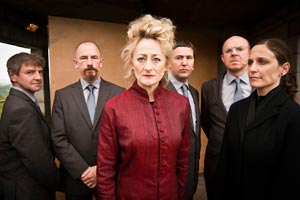
The cast of Mike Pearson's NToW production of The Persians
Even the London critics somehow managed to find themselves seated, not in West End luxury, but on a hard bench, clad in a regulation green poncho and exposed to the elements deep in the heart of the Brecon Beacons.
All have heaped praise on the National Theatre of Wales‘ sixth production in this year’s inaugural programme of The Persians, directed by Mike Pearson.
“They have scored a coup”, The Observer; “Pearson’s superbly imaginative and intense production, at once timeless and modern, has a rare, raw power. This is great theatre – and a thrilling mystery tour for its audience”, The Telegraph; “a production that is both minimalist and massive in its scope and marvellous in its realisation,” the Hereford Times; “what is impressive about Mike Pearson’s production is the totality of the experience”, The Guardian; “some of the finest creative talents working in Wales today… melded together to produce a unique and exciting drama, probably accompanies most artistically fulfilling production to date”, Michael Kelligan; “with the eery music, some wonderful acting and the amazing setting, this is another hit for National Theatre Wales”, Western Mail.
Yes it is all this and more. But for me, on quiet reflection, there is a story behind the production that I haven’t yet seen discussed.
The Persians represents in many ways a Phoenix like rebirth of one of Wales’s greatest theatre companies – Brith Gof. Firstly, director Mike Pearson, conceptual designer Mike Brooks and composer John Hardy were all key players in Brith Gof’s history. Richard Huw Morgan, John Rowley and Gerald Tyler are all actors who have worked often for extended periods for the company. So, as they say: they have form.
I was a trustee of the company when its Arts Council Wales funding was terminated in 2000. The company’s last grant was £52,500. We decided that Brith Gof – always much more appreciated outside of Wales than in it – should continue as long as we could find the money and the directors had the artistic ideas. Mike Pearson and fellow directors Michael Shanks and Cliff McLucas were eventually offered jobs with regular income. In the end, we had to call time in 2004.
It has been both instructive and rewarding to search the archives to see just how much Brith Gof has given to The Persians. Anyone who saw the Welsh production of
Brith Gof's "PAX" at St David's Hall, Cardiff
“Gododdin” (a remarkable film archive is here, persist with it, the video’s not great quality) in the Rover car factory, Cardiff in 1989, “PAX” in St Davids Hall in 1991, or, even Mike Pearson’s two-man show “In Black and White” with disabled actor Dave Levett in 1992, will see the theatrical connections. The use of extraordinary musical soundscapes originated with John Hardy and Mike Pearson’s work with Test Department in the 1980’s. John Hardy’s (interview here) creativity and musical inventiveness hasn’t lost any of its edge in spite of him being a much in demand composer for mainstream film and television (and still, thankfully, based in Wales).
In the last few productions by Brith Gof – such as Hafod, technology began to appear but hand-held video cameras had to be attached to the performers with trailing cables. In The Persians we have a chorus member with a tiny handheld wireless camera and the remarkable camera work of Pete Telfer projecting the live-action onto video screens. The integration of recorded segments of video is also an inheritance from the days when such things were much more technically challenging.
Some things in the Persians are different: as Mike Pearson explains in his interview with me working with a classic text – brilliantly translated by Kaite O’Reilly – was one of his self-set challenges. It was also in English, where much of Brith Gof’s work had been Welsh or bilingual. And whilst I have no idea what the budget of the production was, I imagine that the generous Arts Council Wales and Welsh Assembly Government funding to NToW (£3M over three years) gave the team a little more flexibility than they had in the old days.
For me then, there is much satisfaction in seeing how 15 years of theatrical development in Welsh theatre could have such a stunning, successful and critically acclaimed rebirth. Many theatre companies throughout Europe owe a debt to Brith Gof. I am glad that the National Theatre of Wales, albeit by a kind of proxy, and The Persians has been able to honour it so well.
Footnote: there have been some excellent comments that add to my story and, rather than take the credit for knowledge that I didn’t have, I ask that you click on the comments, if you haven’t already done so.
Good news that the archive may get a new life too!
 Only Connect